Sponsored article
Why Do Cooling and Venting Systems Determine the Quality of Injection-Moulded Parts?
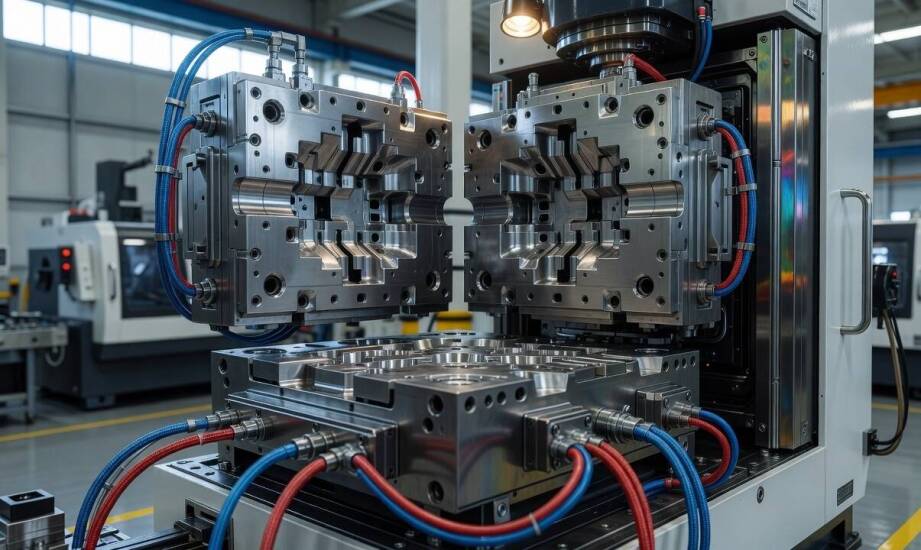
In injection moulding, consistent part quality depends heavily on the design of the mould itself. Even an advanced injection moulding machine cannot fully compensate for fundamental tooling problems.
Read more: The production process of bar mats from PVC: technology and innovation
Cooling channels and venting need to be considered early in the engineering process because they influence dimensional stability, surface quality and production repeatability.
Read more: Low-emission Technologies in Fuel Tank Production: What Should You Know?
A well-designed mould should maintain a sufficiently uniform temperature distribution while allowing trapped air and gases to escape efficiently from the cavity.
Read more: Automation in petri dish production – what benefits does it bring?
How Do Cooling and Venting Affect Moulding Defects?
Uneven heat removal can cause different areas of a moulded part to solidify at different rates.
Thicker sections retain heat longer than thin walls or ribs. If these differences are significant, they can contribute to uneven shrinkage, residual stresses and warpage.
A balanced thermal system helps reduce these effects and improves dimensional repeatability.
This becomes particularly important for complex components and parts that later need to fit precisely into automated assemblies.
Venting performs a different but equally important function.
As molten polymer enters the cavity, it pushes the air in front of the flow. If this air cannot escape effectively, it becomes compressed.
The resulting rise in pressure and temperature can cause local burn marks known as the diesel effect.
Insufficient venting can also contribute to incomplete filling, particularly at the end of the flow path, and may affect the appearance and strength of weld lines where separate melt fronts meet.
Small venting gaps are therefore positioned in suitable areas of the mould, often around the parting line or other locations where trapped air is expected.
Their dimensions need to suit the material being processed. Vents that are too restrictive may not remove air effectively, while excessive vent depth can allow molten polymer to enter the gap and produce flash.
How Does Cooling-Channel Geometry Affect Series Production?
Cooling is usually one of the longest stages of an injection moulding cycle.
The part needs to reach a sufficiently low and uniform temperature before it can be ejected without excessive deformation.
An efficient cooling system can therefore influence both part quality and production cost.
Cooling channels should be positioned so that heat is removed as evenly as practical from the cavity. Large temperature differences within the mould can increase the risk of uneven shrinkage and warpage.
For high-volume production, even a relatively small reduction in cooling time can have a significant effect on total production time.
For more complex components, conventional straight drilled channels may not always provide the most efficient solution.
Some advanced injection mould for plastic designs can use conformal cooling, in which cooling channels follow the geometry of the moulded component more closely.
This approach can improve temperature distribution and, where the geometry allows it, reduce cooling and overall cycle time.
How Does the Polymer Affect Mould Design?
Different polymers require different thermal and processing conditions.
Amorphous materials such as ABS generally behave differently during cooling from semi-crystalline polymers such as PA.
Semi-crystalline materials undergo crystallisation as they cool, which influences their shrinkage and dimensional behaviour.
For PA6, the final shrinkage depends on the specific grade, part geometry, processing parameters and any reinforcing fillers.
Glass-fibre reinforcement, for example, can reduce shrinkage in some directions and improve dimensional stability, while also introducing anisotropic behaviour that needs to be considered during design.
Mould temperature is therefore not simply a machine setting selected after the tool has been built.
The polymer and its processing requirements should be considered during mould design itself.
Cooling layout, gate position, wall thickness and venting all need to work together with the properties of the chosen material.
Noex combines plastic-part design, tool manufacturing and injection moulding within its production process.
The company designs and manufactures injection moulds and works with different polymers and composites, allowing material requirements to be considered from the tooling stage through to series production.
Why Is Vent Location Important?
Vents are most effective when placed where air is naturally pushed during cavity filling.
These locations often include:
the end of the flow path;
areas behind ribs or cores;
locations where two melt fronts meet;
selected areas along the parting line.
Flow simulation can support this process by showing how the cavity is likely to fill and where air traps may occur.
The result needs to be verified during mould trials, because actual filling behaviour also depends on processing conditions and the material used.
If burn marks, short shots or weak weld lines appear during testing, venting is one of the areas that should be investigated.
Precision Engineering Supports Efficient Production
Reliable injection moulding depends on controlling both heat transfer and material flow.
The injection machine determines parameters such as injection speed, pressure and clamping force, but the mould itself determines how effectively heat can be removed and trapped gases released.
For that reason, tooling problems cannot always be solved simply by changing machine settings.
Correct mould design needs to consider:
cooling efficiency;
temperature distribution;
vent locations;
gate and flow behaviour;
material shrinkage;
part geometry.
This is particularly important in series production, where a small instability repeated over thousands or millions of cycles can result in considerable scrap, dimensional variation or unnecessary cycle time.
Careful engineering at the CAD and tooling stages therefore supports both consistent part quality and economical production.
FAQ
Why Is the Cooling System So Important in an Injection Mould?
The cooling system removes heat from the moulded component. Balanced cooling helps reduce warpage and residual stresses, improves dimensional stability and can shorten the production cycle.
What Are the Signs of Poor Mould Venting?
Typical symptoms include burn marks, incomplete filling, poor surface quality and problems around weld lines. Trapped air can also contribute to inconsistent mould filling.
What Is Conformal Cooling?
Conformal cooling uses channels designed to follow the geometry of the moulded part more closely than conventional straight drilled channels. This can improve heat removal and temperature uniformity in suitable applications.
How Does the Type of Plastic Affect Injection Mould Design?
Polymers differ in shrinkage, thermal behaviour, viscosity and crystallisation. A mould intended for ABS may therefore require different processing and thermal conditions from one designed for PA6 or PP.
Can a Modern Injection Moulding Machine Compensate for Poor Mould Design?
Only to a limited extent. Advanced process controls can help optimise and stabilise production, but they cannot fully eliminate problems caused by inadequate cooling, poor venting or fundamental tooling errors.
You might be interested

Key Benefits of Choosing Polish Mushrooms for a Seasonal Menu
The importance of flexibility in adapting pork products to customer needs

How do Cracow renovation experts ensure the timeliness and reliability of work?